Table of Contents
ToggleWhen a Kenmore refrigerator starts acting up, whether it’s running warm, making strange noises, or refusing to dispense ice, the first instinct is often to call for help. But many common issues can be diagnosed and repaired by homeowners with basic tools and a methodical approach. Kenmore appliances, manufactured by various suppliers for Sears, share components with brands like Whirlpool, LG, and Frigidaire, which means parts are readily available and repair guides are plentiful. This guide walks through the most frequent Kenmore refrigerator problems, helping readers decide when to tackle repairs themselves and when to bring in professional kenmore dishwasher repair services.
Key Takeaways
- Many common Kenmore refrigerator repair issues—such as clogged defrost drains, faulty thermistors, and door gasket problems—can be safely diagnosed and fixed by homeowners using basic hand tools and a multimeter.
- Kenmore refrigerator repair near you typically costs $75–$150 for a service call, but compressor replacement can reach $400–$800, making replacement more economical for units over 10 years old.
- Warm compartments, ice buildup, and water pooling usually stem from defrost system failures, evaporator fan malfunctions, or gasket issues—all repairable without professional help.
- Professional kenmore refrigerator repair is necessary only for refrigerant leaks, compressor replacement, sealed system repairs, and major electrical faults that require EPA certification.
- Regular maintenance—clearing condenser coils, unclogging defrost drains, and adjusting leveling legs—prevents most problems and reduces costly service calls.
- Always unplug the unit before opening panels, reference the wiring diagram, take photos before disconnecting components, and order parts from reputable suppliers to avoid universal replacements that don’t fit properly.
Diagnosing Common Kenmore Refrigerator Problems
Start by observing symptoms carefully. A warm fridge compartment but functioning freezer often points to a defrost system failure or evaporator fan issue. If both compartments are warm, check whether the compressor is running, place a hand on the back lower panel to feel for vibration and warmth. No vibration usually means a failed compressor or a tripped overload relay.
Water pooling inside typically originates from a clogged defrost drain. This drain tube runs from the freezer floor down to a pan beneath the unit and can freeze shut or collect debris. Ice buildup on freezer walls suggests a door seal (gasket) problem or a malfunctioning defrost heater.
No cooling at all warrants an immediate check of the power supply, confirm the outlet works by plugging in another device. Verify the temperature control isn’t accidentally set to zero. If the compressor cycles on briefly then shuts off, the start relay or overload protector might be faulty.
For models with digital displays, error codes can simplify diagnosis. Consult the user manual or search the model number (usually found on a sticker inside the fridge or on the back panel) paired with the error code online. Many Kenmore models share diagnostic modes accessible by pressing specific button combinations on the control panel.
When to DIY vs. When to Call a Professional
Safe for DIY:
- Replacing door gaskets, water filters, or light bulbs
- Cleaning condenser coils (located on the back or beneath the unit)
- Unclogging defrost drains with warm water and a turkey baster
- Swapping out the defrost timer, thermistor, or start relay (all plug-in components)
- Adjusting temperature controls or resetting the control board
- Replacing water inlet valves or ice maker assemblies (requires shutting off the water supply)
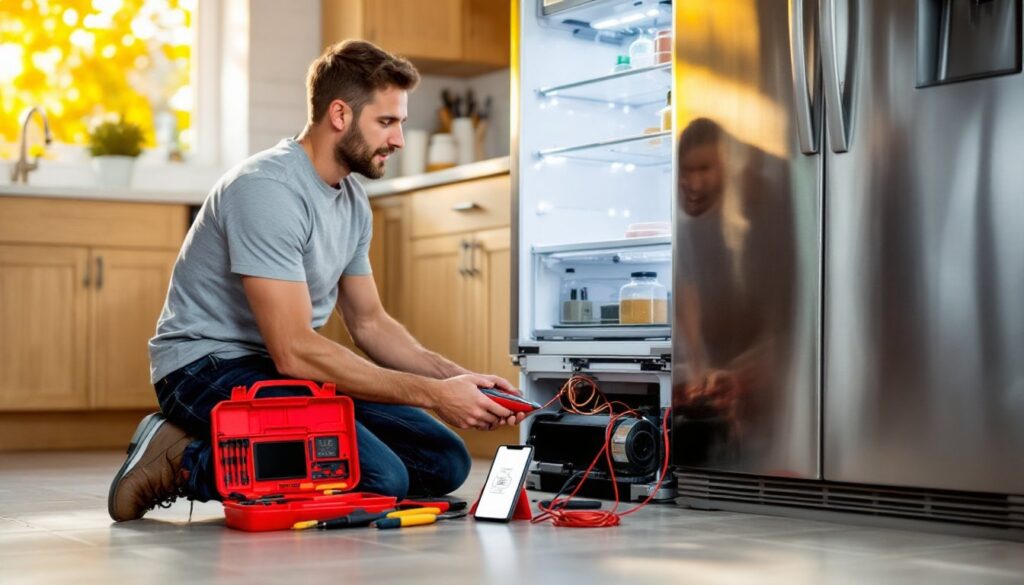
These tasks require basic hand tools, screwdrivers, a nut driver set (1/4″ and 5/16″ are most common), needle-nose pliers, and a multimeter for testing electrical continuity. Always unplug the refrigerator or flip the circuit breaker before opening any panels or touching wiring.
Call a professional for:
- Refrigerant leaks or compressor replacement (requires EPA 608 certification to handle refrigerants legally)
- Major electrical faults involving the main control board in high-voltage sections
- Sealed system repairs (evaporator or condenser coil replacement)
- Situations where manufacturer warranty coverage is still active
If searching for kenmore refrigerator repair near me or kenmore elite refrigerator repair near me, expect service call fees ranging from $75 to $150 before parts and labor. Compressor replacement can run $400 to $800, often making it more economical to replace older units.
Many experienced appliance repair professionals offer flat-rate diagnostics. If the repair estimate exceeds 50% of a new appliance’s cost, replacement usually makes better financial sense, particularly for units over 10 years old.
Fixing Temperature Control Issues
When the fridge runs too warm or too cold, start by checking air circulation. Overloading shelves blocks vents that channel cold air from the freezer into the refrigerator compartment. Remove items blocking these vents (usually located on the back wall or ceiling of the fridge section) and allow 24 hours to see if temperatures stabilize.
Test the thermistor (temperature sensor), a small probe with two wires typically mounted near the evaporator coils. Unplug the fridge, remove the freezer’s back panel (usually 4 to 6 screws), and disconnect the thermistor. Set a multimeter to ohms and test resistance, at room temperature (around 70°F), resistance should read approximately 10,000 to 11,000 ohms. If it reads infinite or zero, replace it. Thermistors cost $15 to $30.
The defrost timer controls the automatic defrost cycle. If it fails, frost accumulates on evaporator coils, restricting airflow and raising temperatures. The timer is usually behind the kickplate below the door or inside the control housing. Turn the timer’s dial with a flathead screwdriver until the compressor shuts off and the defrost heater activates. If nothing happens, the timer needs replacement ($20 to $50).
A faulty evaporator fan (located in the freezer behind the back panel) can also cause warm temperatures. With the freezer door open, press the door switch to simulate a closed door. The fan should run. If it’s silent, test it with a multimeter or replace it (typically $40 to $80). Worn fan motors often produce a grinding or squealing noise before they fail completely.
Repairing Water and Ice Dispenser Problems
No water dispensing often stems from a frozen or kinked water line. Turn off the water supply valve (usually behind the fridge or under the sink), disconnect the 1/4″ supply line at the back of the unit, and blow through it to check for blockage. If water previously dispensed slowly, the filter might be clogged, filters should be replaced every six months regardless of usage.
The water inlet valve, located at the back lower section where the water line connects, controls flow to both the dispenser and ice maker. Test it with a multimeter set to ohms, typical resistance is 500 to 1,500 ohms between terminals. If it reads infinite or zero, replace it ($25 to $60). Inlet valves require a minimum water pressure of 20 psi to function: low pressure can cause slow dispensing or hollow ice cubes.
For ice maker problems, verify the shut-off arm isn’t in the raised (off) position. Check for ice jams in the dispenser chute, removing the ice bucket and clearing any blockages often solves dispensing failures. If the ice maker produces no ice, ensure the freezer temperature is 0°F to 5°F: warmer temperatures prevent proper ice formation.
A malfunctioning ice maker module (the motor and control assembly) is common in units over five years old. Replacement modules ($60 to $120) are model-specific, so confirm compatibility before ordering. Installation involves unplugging the unit, removing the ice bucket and mounting screws, disconnecting the wiring harness, and reversing the process with the new module. If you’re uncomfortable with appliance repair tasks, kenmore dishwasher repair specialists can handle ice maker replacements as well.
Addressing Unusual Noises and Vibrations
Buzzing or humming every few hours is normal, it’s the defrost timer cycling or the compressor starting. Continuous loud humming suggests a struggling compressor or faulty start relay. The relay attaches to the compressor (lower back of the unit) and can be tested by shaking it: rattling indicates internal damage. Replacement relays cost $10 to $25.
Clicking that repeats without the compressor starting points to a failed relay or overload protector. Both components are inexpensive and plug onto the compressor’s terminals. Before handling, unplug the fridge and discharge the run capacitor (if present) using an insulated screwdriver across the terminals, wear safety glasses.
Rattling often comes from items on top of the fridge, loose drain pans beneath the unit, or condenser coils vibrating against the back panel. Pull the fridge away from the wall, vacuum the condenser coils (dirty coils force the compressor to work harder and vibrate more), and ensure the unit sits level. Adjust the front leveling legs so the fridge tilts slightly backward, this helps doors close automatically and reduces vibration.
Grinding or squealing from inside the freezer indicates a failing evaporator fan motor. This requires removing the back panel inside the freezer (defrost any ice buildup first using a hairdryer on low, keeping it at least 6″ from plastic components). A new fan motor typically costs $40 to $80 and installs with two screws and a wiring connector.
Water dripping sounds behind the back panel are usually normal, it’s condensation dripping onto the defrost heater during the defrost cycle. If dripping is constant or pooling occurs inside, revisit the defrost drain troubleshooting outlined earlier.
Essential Tools and Replacement Parts for Kenmore Repairs
Basic Tool Kit:
- Nut driver set (1/4″, 5/16″, 3/8″)
- Phillips and flathead screwdrivers (multi-bit driver saves space)
- Multimeter with continuity testing (digital models under $20 work fine)
- Needle-nose pliers and standard slip-joint pliers
- Flashlight or headlamp (interior panels are poorly lit)
- Putty knife or trim removal tool (for prying off kickplates without damage)
- Shop towels and a bucket (for water line disconnection)
Common Replacement Parts:
Kenmore model numbers often start with 253, 596, or 795. The full model number (usually 10+ digits) is critical for ordering correct parts. Cross-reference with the part manufacturer’s listings, many Kenmore parts interchange with Whirlpool, LG, or Electrolux components.
- Defrost timer ($20-$50)
- Thermistor/Temperature sensor ($15-$30)
- Door gasket ($50-$100, varies by door size)
- Water inlet valve ($25-$60)
- Ice maker assembly ($60-$120)
- Evaporator fan motor ($40-$80)
- Compressor start relay and overload ($10-$25)
Order from appliance parts suppliers like RepairClinic, AppliancePartsPros, or Reliable Parts. Avoid generic “universal” parts for electrical components, they rarely fit properly and can cause further issues.
Safety Gear:
- Work gloves (for handling sharp sheet metal edges inside panels)
- Safety glasses (especially when working near capacitors or compressed components)
- Knee pads if working on lower components for extended periods
Always reference the wiring diagram located inside the unit (usually taped inside the control housing or behind the kickplate). Take photos with a smartphone before disconnecting any wiring harnesses, this prevents incorrect reassembly. Comparing costs through home improvement platforms can help decide whether parts and time investment justify DIY versus hiring kenmore refrigerator repair services.
Conclusion
Most Kenmore refrigerator issues boil down to a handful of components that homeowners can test and replace with patience and the right tools. Door seals, thermistors, inlet valves, and fan motors account for the majority of service calls, yet none require specialized training to swap out. Keep the model number handy, invest in a basic multimeter, and don’t skip the defrost drain cleaning during routine maintenance, it’s the simplest fix that gets ignored until water pools on the floor. For sealed system work or complex electrical faults, professional kenmore refrigerator repair remains the safer and often more economical choice.