Table of Contents
ToggleShark vacuums are workhorses, but even the best machines lose steam after a few years of sucking up cereal crumbs and pet hair. Before you haul yours to the curb or pay for professional service, know this: most Shark vacuum problems can be fixed at home with basic tools and about 30 minutes of your time. Loss of suction, brush roll jams, weird noises, these aren’t death sentences. They’re usually clogs, worn belts, or filters that haven’t been cleaned since 2023. This guide walks through the most common shark vacuum cleaner repair issues, what’s causing them, and how to fix them without a service call.
Key Takeaways
- Most Shark vacuum repair issues—including loss of suction, brush roll jams, and clogs—can be fixed at home in 30 minutes with basic tools and no service call required.
- Empty the dust cup, clean or replace filters every 6–12 months, inspect seals, and check the hose to restore weak suction in 95% of cases without replacing parts.
- Shark vacuum brush roll problems are usually caused by hair tangles, snapped belts ($5–$8 to replace), or a disabled brush switch that’s easy to reset yourself.
- Clear blockages from the floor nozzle, hose, cyclone chamber, and brush roll chamber in sequence to eliminate clogs—the most common reason vacuums lose suction or shut off.
- Replace your vacuum instead of repairing it if the main motor fails, the unit is over 7 years old, you’ve replaced multiple parts in the past year, or repair costs exceed half the price of a new model.
Most Common Shark Vacuum Problems and Quick Diagnoses
Shark vacuums share a handful of recurring issues across models. Recognizing the symptom quickly points to the fix.
Loss of suction is the number one complaint. If the vacuum runs but barely picks up dirt, the culprit is almost always a clog, full dust cup, or dirty filter. Less common: a cracked hose or bad seal around the dust bin.
Brush roll won’t spin. This shows up as poor carpet cleaning or a burning smell. Check for hair wrapped around the roller, a snapped belt, or a tripped brush roll switch. Some models have a manual on/off button for the brush that’s easy to bump.
Vacuum shuts off randomly. Overheating triggers a thermal cutoff. Usually caused by blockages restricting airflow or a filter so clogged the motor can’t breathe. Let it cool 45 minutes, clear the obstruction, and it’ll reset.
Loud rattling or grinding noise. Something’s stuck in the brush housing, the belt is shredded, or the motor bearings are shot. The first two you can fix: bearing failure means motor replacement or a new vacuum.
Dust escapes from the exhaust. Your HEPA or foam filter is either missing, installed backward, or past its lifespan. Shark recommends replacing foam and felt filters every 6–9 months depending on use.
Always unplug the vacuum before any disassembly. Wear safety glasses if you’re prying off stuck parts or cutting tangled hair, small springs and clips can pop out under tension.
How to Fix Loss of Suction in Your Shark Vacuum
Weak suction is fixable 95% of the time without replacing parts. Start with the fastest checks and work deeper.
Empty the dust cup. Shark recommends emptying when debris reaches the max fill line, but suction drops off well before that. Empty it, then rinse the cup with warm water and let it air-dry completely, 24 hours is safest. Moisture left inside will cake onto dirt and clog the cyclone.
Clean or replace all filters. Sharks typically have a pre-motor foam filter and a post-motor HEPA filter. Pop both out (consult your model’s manual for location, usually under a hinged door or behind the dust cup). Tap off loose dust outside, then rinse foam and felt filters under a faucet until water runs clear. Never wash HEPA filters unless the manual specifically says they’re washable. Most are not: replace them every 12 months. Let washable filters dry completely before reinstalling.
Inspect seals and gaskets. The dust cup lid and canister body have rubber seals. If they’re cracked, compressed flat, or coated in grime, air leaks kill suction. Wipe them down with a damp cloth. Replacement seals are available from Shark or third-party suppliers for $5–$10.
Check the hose. Detach the hose (usually a button-release or twist collar) and hold it up to a light. Look for cracks or holes. Flex it gently, splits often hide in accordion folds. A small crack can be patched temporarily with Gorilla tape, but replacement hoses run $15–$30 and are the permanent fix.
If suction is still weak after all that, the issue may be internal, a broken cyclone seal or a failing motor. At that point, repair cost approaches replacement cost for most models.
Repairing Brush Roll Issues and Motor Problems
When the brush roll stops spinning, carpets don’t get cleaned. Here’s how to get it moving again.
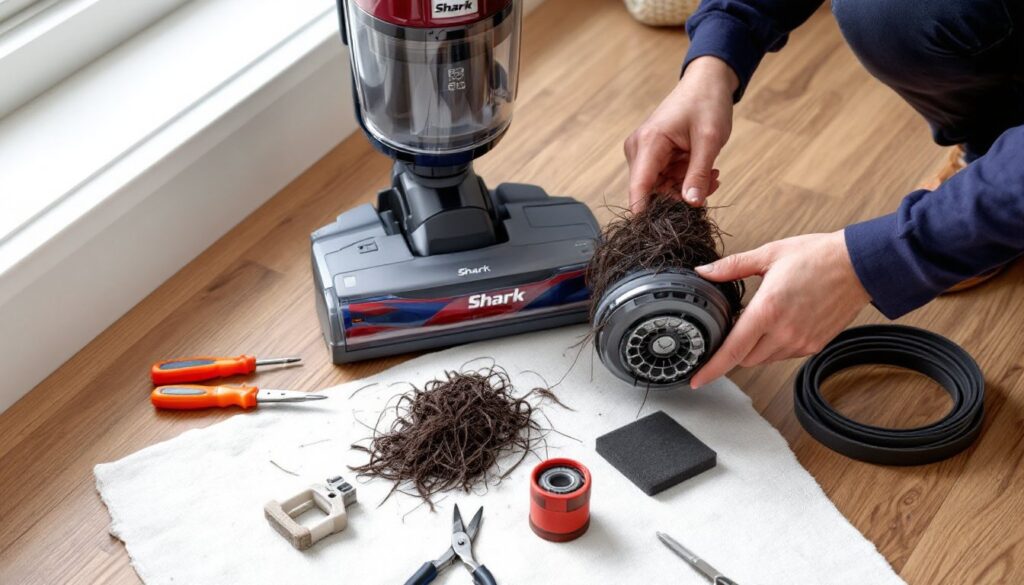
Remove hair and debris. Flip the vacuum over and locate the brush roll cover, usually held by 3–5 screws or twist tabs. Remove the cover and lift out the roller. Hair wraps tight around the bearing ends and center bristle section. Use scissors or a seam ripper to cut through the tangle, then pull it free. Avoid cutting the bristles themselves. Reinstall the roller and test.
Inspect the belt. The belt loops around the motor shaft and brush roll. If it’s snapped, stretched, or glazed (shiny and slick), it won’t transfer power. Shark belts are model-specific: check your user manual or the label inside the brush compartment for the part number. Replacement belts cost $5–$8 for a two-pack. Slip the new belt over the motor spindle first, then stretch it onto the brush roll while seating the roller back into its slots. It should feel snug.
Check the brush roll switch. Many Shark uprights have a floor/carpet selector or a dedicated brush on/off button. Make sure it’s in the correct position. Some models disable the brush automatically when the handle is upright for above-floor cleaning.
Test the motor. If the belt is intact and there’s no hair, but the roller still won’t turn, the brush motor may be dead. This is more common in older models or after a thermal shutdown event. Replacing a brush motor requires disassembly of the floor nozzle and soldering or connector work. Unless you’re comfortable with small motor repair, this job is best left to a pro, or it’s time to consider a new vacuum.
Listen for bearing noise. If the roller spins but sounds like gravel in a blender, the plastic bearings are worn. Some rollers have replaceable end caps: others require a full roller replacement ($12–$25). Continued use with bad bearings can burn out the motor.
Fixing Clogs and Blockages in Hoses and Airways
Clogs are the most common reason a Shark vacuum loses suction or shuts off mid-clean. They hide in places you don’t think to check.
Start at the floor nozzle. Flip the vacuum over and shine a flashlight into the suction inlet. Socks, twist ties, and chunks of cardboard love to wedge here. Use needlenose pliers or a coat hanger to fish them out.
Check the hose. Detach the hose at both ends. Look through it toward a light source, if you can’t see through, it’s blocked. A straightened wire coat hanger or a plumbing snake works for pushing clogs through. For stubborn blockages, wet paper towels or matted pet hair, try running warm water through the hose (only if you have 24 hours to let it dry). Some DIYers use a leaf blower to reverse-blast clogs, which works but is messy. Do it outside.
Inspect internal airways. Remove the dust cup and look into the cyclone assembly. Clogs often form at the narrow transition between the hose inlet and the cyclone chamber. Use a flashlight and a long screwdriver wrapped in a paper towel to clear packed debris. On some models, the cyclone unscrews for deeper access, check your manual.
Clean the brush roll chamber. Even if the roller spins, the airway around it can clog with compacted lint and hair. This is especially common if you vacuum up fine dust (drywall, fireplace ash, or craft glitter). Remove the roller and wipe out the cavity with a damp rag.
Several DIY repair tutorials emphasize clearing every airway in sequence, if you skip one, the vacuum will still underperform. After clearing blockages, reassemble everything and run the vacuum for 30 seconds with no attachments to purge residual debris.
Replacing Worn Belts, Filters, and Essential Parts
Even with good maintenance, some parts wear out. Replacing them is cheaper than a new vacuum and usually takes less than 15 minutes.
Belts stretch or snap after 12–18 months of regular use, sooner if you vacuum thick carpet or frequently hit obstacles. Always buy the correct part number for your Shark model, generic “universal” belts often don’t fit right. Installation is straightforward: remove the old belt, loop the new one over the motor shaft, stretch it onto the brush roll, and snap the roller back into place. If the belt slips off repeatedly, the motor shaft or roller post may be worn smooth.
Filters are a scheduled replacement, not a repair. Shark’s foam and felt filters are washable, but after 6–9 months they lose structural integrity and stop filtering fine dust. HEPA filters are typically good for 12 months. Non-OEM filters are available for less, but quality varies, cheap filters can shed fibers into the motor. Testing by product review organizations shows that OEM filters consistently outperform generics in particulate capture.
Dust cup and lid assemblies. Cracks in the dust cup or a broken latch on the lid are common after a few years. Replacement cups run $20–$40 depending on model. Some are available through Shark’s parts site: others show up on Amazon or eBay. Make sure the part number matches.
Hoses and nozzle attachments. Hose replacements are about $15–$30. Attachments like crevice tools and upholstery brushes are often cheaper to replace than to repair if the clips break.
Where to buy parts: Shark’s official parts site, Amazon, and vacuum specialty retailers like eVacuumStore all stock common parts. For discontinued models, check eBay or local vacuum repair shops, they often have used parts bins.
Keep your model number handy (it’s on a sticker on the back or bottom of the vacuum). Part compatibility varies wildly even within the same product line.
When to Repair vs. Replace Your Shark Vacuum
Not every problem is worth fixing. Here’s how to decide.
Repair if:
- The vacuum is less than 5 years old and the issue is a clog, belt, filter, or hose.
- Replacement parts cost under $50 and you’re comfortable doing the work.
- The motor runs strong and there’s no burning smell or smoke.
- It’s a higher-end model (Shark’s Apex, Vertex, or Stratos lines hold value longer).
Replace if:
- The main motor is dead. Motor replacements cost $80–$150 for parts alone, plus labor if you can’t do it yourself. At that price, you’re near the cost of a new mid-range vacuum.
- The vacuum is over 7 years old. Plastic housings become brittle, seals degrade, and parts availability drops for discontinued models.
- You’ve already replaced multiple components in the past year, you’re chasing a losing battle.
- There’s visible damage to the body or floor nozzle that affects structural integrity (cracked housing, broken axle mounts).
Cost comparison: A basic Shark Navigator runs $120–$150 new. If repairs exceed half the replacement cost, it’s usually smarter to upgrade, especially if newer models have features you want (better filtration, lighter weight, longer cord).
Safety note: Never attempt to repair electrical components (switches, motors, power cords) unless you have experience with appliance wiring. Improper work can create shock or fire hazards. Consult workshop guides for power tool and appliance safety if you’re uncertain.
Shark offers a 5-year limited warranty on most models. If your vacuum is still covered, contact their support line before doing DIY repairs, opening the housing may void the warranty. Keep your purchase receipt and register the product online to streamline warranty claims.
Conclusion
Most Shark vacuum problems, loss of suction, brush roll jams, clogs, are easy fixes that don’t require special skills or expensive parts. Clean the filters, clear the airways, check the belt, and you’ll solve 90% of issues in under an hour. Keep a spare belt and replacement filters on hand so you’re not stuck mid-project. When repair costs approach half the price of a new unit or the motor’s shot, it’s time to upgrade. But until then, a little maintenance keeps your Shark running strong for years.